
Why using female manikins in CPR training is vital
Why Using Female Manikins in CPR Training Is Vitally Important
When we talk about improving survival rates from out-of-hospital cardiac arrest, we often focus on response times, defibrillators, and compression quality. But there is another, less discussed factor that plays a critical role: confidence.
And confidence starts in training.
The Male Default in CPR Training
Multiple research reviews have identified a consistent issue within resuscitation education: the vast majority of CPR manikins are anatomically “neutral” or male-default — typically lean, flat-chested torsos. In some market analyses, as little as 5% of available models include female-specific anatomy, and almost all training providers do not use female specific manikins in any of their training delivery.
On the surface, this may not seem significant. After all, the mechanics of CPR — hand placement on the centre of the chest, compression depth, rate etc. do not differ between men and women.
But human psychology does.
Observational studies of out-of-hospital cardiac arrest have repeatedly shown that women are less likely to receive bystander CPR than men. Researchers suggest that one contributing factor is hesitation — often linked to discomfort around female anatomy or concern about inappropriate touching in a public setting.
If the first time someone has to perform CPR on a woman is during a real emergency, uncertainty can creep in. And in cardiac arrest, hesitation costs lives.
Why Incorporating Female Manikins Matters
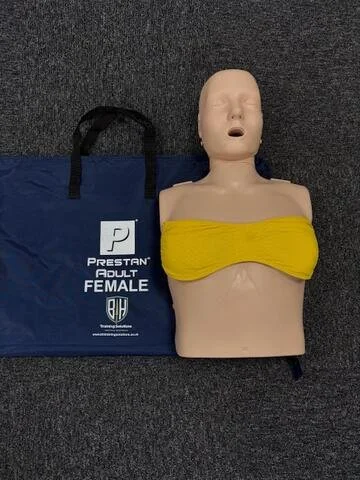
A BH training solutions female CPR manikin
1. Reducing Gender-Linked Hesitation
Training should normalise reality.
When learners practice compressions on both male and female anatomical models, they become familiar with variations in chest shape and presentation. This reduces subconscious discomfort and eliminates the “novelty factor” during a real incident.
The result? Faster action, fewer doubts, and greater willingness to intervene. Becoming a BH UP-Stander, not remaining a BY-Stander like everyone else.
Confidence is not just about knowing what to do, it’s about feeling completely prepared to do it on anyone.
2. Improving Realism and Psychological Readiness
High-quality simulation is built on realism (being a veteran owned and delivered training provider we know this importance more than most). If our training environment does not reflect the diversity of the population we serve, it is incomplete.
Incorporating female manikins increases simulation fidelity. It enhances psychological preparedness and reinforces that CPR is a lifesaving intervention that transcends gender.
When training mirrors reality, performance improves.
3. Addressing Survival Disparities
Data from resuscitation registries show that women experience lower rates of bystander CPR in public cardiac arrests compared to men.
While the causes are multifactorial, training representation is a modifiable factor. By ensuring exposure to female-specific manikins during CPR education, providers can help close the confidence gap that may contribute to unequal intervention rates.
Improving training inclusivity is one practical step toward improving survival equity.
Our Approach at BH Training Solutions
At BH Training Solutions, we deliberately incorporate female-specific CPR manikins into our courses.
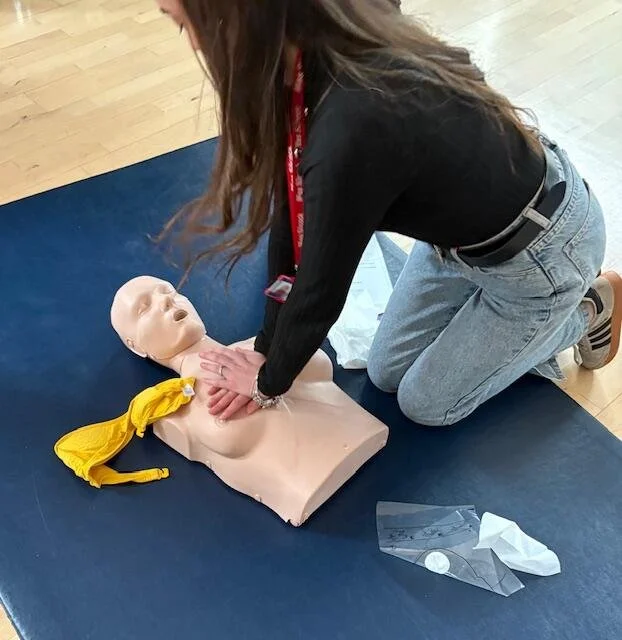
One of our learners in action during a recent BH training solutions on-site first aid course utilising one of our female CPR manikins
We do this because:
Training should reflect real-world anatomy.
Confidence should apply to every casualty.
No one should miss out on life-saving intervention because a rescuer hesitated.
If we expect people to act decisively in a high-stress emergency, we must ensure their training environment prepares them fully — not partially.
The Evidence Is Clear
Emerging research consistently demonstrates:
Standard CPR training overwhelmingly relies on male-default or anatomically neutral manikins.
Underrepresentation of female anatomy may contribute to lower confidence when performing CPR on women.
Exposure to female-anatomy manikins increases comfort levels and self-reported confidence in trainees.
This is not about changing CPR technique.
It is about removing barriers to action.
Conclusion:
CPR is simple. Cardiac arrest is not selective. Confidence must be universal.
Male-default training models remain dominant in most environments, but that lack of anatomical diversity has real implications. When learners are unfamiliar with female anatomy in a training context, hesitation and doubt can surface during a real emergency.
Incorprating female manikins improves:
Confidence
Realism
Inclusivity
Preparedness
Ultimately, it may help reduce disparities in bystander CPR and improve outcomes for women experiencing cardiac arrest.
If we want equal chances of survival, we must start with equal representation in training.
This is where BH training solutions can help.
For all your on-site first aid training requirements delivered by highly experienced veterans reach out today, contact us via our website by clicking here:
BH training solutions | Enhance Skills Today – Get Trained
Blog author: Ben Holroyd - founder & lead instructor BH training solutions